14 July 2026, 16:19 – TradeWinds News
Uncertain geopolitics now a major deciding factor for shipowners when signing shipyard contracts
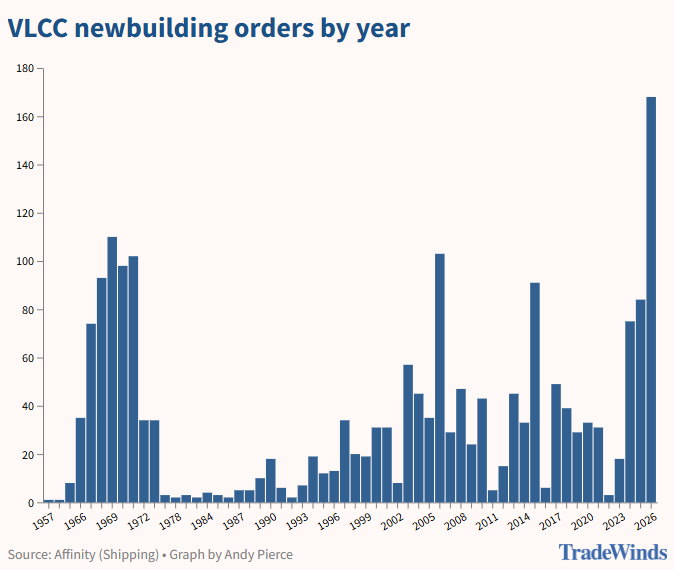
VLCC newbuilding orders have set record highs this year, shattering the figure contracted at the height of the last super-cycle and the historic order boom in the late 1960s.
According to Veson Nautical, orders for VLCCs have surged by a factor of almost 10 against the same period a year ago.
“197 VLCCs have been ordered so far in the first half of 2026 compared to just 24 over the same period last year,” Veson Nautical analyst Rebecca Galanopoulos told TradeWinds.
Data from Affinity records 168 new VLCCs ordered this year, dwarfing the previous record of 110, set back in 1969.
The only other years on record with more than 100 VLCCs contracted came in 1971 (102) and 2006 (103), Affinity’s figures show.
Hengli Shipbuilding has dominated the market with 86 of the 2026 total, Dalian Shipbuilding Industry Co is in second with 18, according to the broker’s figures. South Korea’s Hanwha Ocean is third with 16 VLCC orders this year.
Bimco shipping analysis manager Filipe Gouveia said 2026 has seen the highest crude tanker contracting on record
For the first half of 2026, VLCC orders also made up 78% of the tanker orderbook, chartering platform Signal Ocean said.
“The 2008 record has been broken in a single half-year,” Signal Ocean said.
The rate at which orders were made was also unprecedented.
MJLF’s Lauren Gallinari said: “The ordering pace is already more than double the total contracted during the full year of 2025 and more than eight times the number ordered just three years ago, and it’s only July.”
As TradeWinds reported last week, newbuilding investments have been running hot this year.
Greek owners contracted twice as many newbuildings in the first half of the year as they acquired secondhand, underscoring the scale of their fleet renewal programme.
As we reported back in early March, shipowners had ploughed over $10bn into VLCC newbuildings in a three-month order spree almost unmatched in history.
The spike in demand had led to newcomers being attracted to the space from the shipbuilding and shipowning side. Despite a dip around the beginning of the Iran conflict, appetite has since returned.
Shipowners are not deterred by price, with VLCC newbuildings costing $131m each, according to MJLF.
Secondhand scarcity
The red-hot demand for VLCC newbuildings has also filtered into the secondhand market.
Galanopoulos noted that there were 127 VLCC sales in the first six months of 2026 compared to 85 in the whole of 2025.
About half of the VLCC sales were driven by Sinokor’s buying spree at the beginning of the year, backed by Aponte’s MSC Mediterranean Shipping Company.
Values of secondhand VLCCs were also at record highs, said Signal Ocean, almost unmatched in history.
“Five-year-old VLCCs are now valued at $174.5m, compared with a newbuilding price of $129.8m, as buyers continue to pay a premium for prompt availability.”
However, with available tonnage becoming more difficult to source, shipowners will still turn towards newbuildings as the more realistic route to fleet growth, even with three-to-four-year lead times, Galanopoulos said.
Gouveia added: “High freight rates and the need to replace an increasingly older fleet have both also encouraged contracting.”
Overdue fleet renewal
Gouveia noted that the average age of the VLCC fleet has been growing since 2011 to 14 years old today.
MJLF sees no cause to worry about overtonnaging, seeing a similar trend.
“The global VLCC fleet stands at approximately 926 vessels and, on paper, adding another 295 ships sounds substantial,” Gallinari said.
The analyst pointed out that of the 926 VLCCs in service, 205 were operating within sanctioned or shadow trades.
Gallinari explained that with close to 22% of the VLCC fleet more than 20 years old, the new tonnage is well-placed to take over existing business.
Banchero Costa’s Ralph Leszczynski agreed: “We have plenty of margin to absorb new tankers.
“Demolition activity has been very low in recent years as most old tonnage has found employment either as storage or in the shadow fleet,” he said.
“But the moment all the sanctioned trades no longer apply, the vast majority of such vessels would go straight for scrap.”
Geopolitics driver
Further VLCC newbuildings are expected into the next half of 2026, analysts told TradeWinds.
“The current Hormuz crisis will force countries such as China and India to boost their strategic stockpiles, which will boost oil demand in the coming years beyond actual consumption levels,” Leszczynski said.
The medium- to long-term consequences of the Hormuz crisis appear positive for oil trade and for tanker demand, and this is also encouraging investment into VLCCs, he added.
Gallinari noted that shipowners did not seem to mind committing billions of dollars for historically high asset prices because they were factoring geopolitical uncertainty into the equation.
“That’s not speculation born of exuberance. It’s a reflection of how they believe the world is evolving,” she said.
Galanopoulos noted that shifts in trade policy earlier in 2026 played a role in shaping the ordering environment.
“One-year time-charter rates remain well above where they were a year ago, and charterers are comfortable committing to forward delivery given the strength of current earnings,” Galanopoulos said.
“Taken together, the underlying drivers of this cycle look set to persist, even if the pace moderates somewhat from the extremes of the first half,” she added.
Source: TradeWinds / Br8